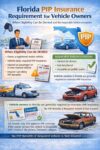
When Insurers Can Deny PIP Eligibility and the Inoperable Vehicle Exception
Florida law requires most vehicle owners to carry Personal Injury Protection (PIP) insurance. This requirement does more than mandate coverage. It directly affects whether an injured person is eligible to receive PIP benefits after a motor vehicle accident.
Failure to comply with Florida’s PIP ownership requirements can result in a complete denial of PIP benefits, even if the injured person was not driving their own vehicle at the time of the accident.
Florida’s Mandatory PIP Requirement
Under Florida law, any person who owns a motor vehicle registered in Florida and designed to be operated on public highways is required to maintain:
- At least $10,000 in Personal Injury Protection (PIP) coverage
- At least $10,000 in Property Damage Liability (PDL) coverage
This requirement applies regardless of whether the vehicle is:
- Frequently driven
- Occasionally driven
- Not involved in the accident at issue
The obligation is tied to ownership, not usage.
Why Ownership Matters for PIP Eligibility
Florida’s PIP statute operates on a pay to play system. If you are required to carry PIP but fail to do so, you may lose the right to receive PIP benefits altogether.
An insurer may deny PIP eligibility when:
- The injured person owns a motor vehicle
- That vehicle is required to be insured under Florida law
- The vehicle is not insured with PIP at the time of the accident
This denial can apply even if:
- The accident occurred in another vehicle
- The injured person was a passenger
- The accident involved a non owned vehicle
In short, owning an uninsured vehicle that should have PIP can disqualify an injured person from receiving PIP benefits.
Common Scenario Leading to Denial
A frequent issue arises when an injured person claims PIP benefits under:
- A resident relative’s policy
- A policy covering the vehicle they were occupying
- Another available PIP policy
If the insurer discovers that the injured person owns an uninsured vehicle, the insurer may deny eligibility entirely based on statutory noncompliance.
The Inoperable Vehicle Exception
Florida law recognizes an important exception to the PIP ownership rule. An insurer may not deny PIP eligibility solely because a person owns a vehicle that is inoperable.
What Is an Inoperable Vehicle
A vehicle may be considered inoperable when it:
- Cannot be driven
- Is not mechanically functional
- Is not capable of being operated on public roads
Examples include vehicles that:
- Have major mechanical failures
- Are missing essential components such as an engine or transmission
- Are permanently disabled or non functional
The key issue is actual operability, not registration status alone.
Evidence Often Used to Prove Inoperability
To establish the inoperable vehicle exception, evidence may include:
- Repair estimates
- Mechanic affidavits
- Photographs of the vehicle
- Testimony regarding the vehicle’s condition
- Storage or non use documentation
Insurers may challenge the exception, so documentation is critical.
Important Distinction Registration vs Operability
A vehicle may still be registered but physically inoperable. Conversely, a vehicle may be unregistered but operable. Florida PIP eligibility focuses on whether the vehicle is capable of operation, not merely whether it appears on DMV records.
Practical Takeaways
- Owning a vehicle in Florida generally requires PIP coverage
- Failure to insure a required vehicle can result in denial of PIP benefits
- Insurers may deny eligibility even if the accident involved another vehicle
- An inoperable vehicle may qualify for an exception
- Proof of inoperability is essential to avoid denial
Why This Issue Matters
PIP eligibility disputes frequently arise after medical treatment has already been rendered. A denial based on ownership and insurance status can leave providers unpaid and injured persons without coverage they expected to receive.
Understanding Florida’s PIP ownership requirements helps:
- Injured persons protect their benefits
- Providers assess coverage early
- Attorneys identify valid coverage defenses
Note: This article is for general educational purposes only and does not constitute legal advice. PIP eligibility determinations depend on specific facts policy language and applicable Florida law.