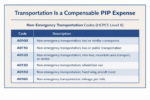
Florida’s Personal Injury Protection statute, section 627.736(1)(a), Florida Statutes, requires insurers to pay eighty percent of all reasonable expenses for medically necessary medical benefits arising from a motor vehicle accident, and Florida courts have interpreted this language to include reasonable transportation expenses incurred to obtain that medical care.
The Florida Supreme Court squarely addressed this issue in Sandra Malu v. Security National Insurance Company.
In that case, insurers took the position that because the PIP statute specifically mentions ambulance services, all other types of transportation were not covered benefits. The Florida Supreme Court rejected this interpretation, holding that the statute does not limit reimbursement to ambulances and does not exclude other reasonable transportation expenses incurred to obtain medically necessary care.
Key Holding
The Court held that:
Transportation costs incurred in connection with obtaining reasonably medically necessary treatment are reimbursable under Florida’s PIP statute.
The Court emphasized that the PIP statute must be liberally construed to effectuate its purpose of ensuring access to medical care following an automobile accident. Transportation that enables a patient to reach medical treatment is incidental to and part of that care, not a separate or excluded benefit .
Why Insurers Still Deny Codes Like A0100
Despite clear precedent, insurers often deny A0100 and related transportation codes using familiar arguments:
- “Transportation is not a listed PIP benefit”
- “Only ambulance services are reimbursable”
- “Mileage or transport is not medically necessary”
- “Transportation is an insured’s personal expense”
These arguments mirror the same reasoning rejected by the Florida Supreme Court.
Bottom Line
Code A0100 represents non-emergency transportation provided so a patient can obtain medical services. When properly documented, it fits squarely within the Supreme Court’s reasoning.
Transportation codes are payable when:
- The patient was injured in a motor vehicle accident
- The medical treatment was reasonable and medically necessary
- The transportation was necessary to obtain that treatment
- The charges are reasonable and properly billed
Providers Should Continue Providing Transportation Services and Challenge Improper Denials
Providers should continue to serve their patients, bill appropriately, and challenge improper denials with confidence grounded in settled law.
- Continue providing transportation when it is reasonably necessary
- Bill transportation services accurately and consistently
- Maintain documentation linking transportation to medical necessity
- Challenge improper denials through presuit demands and litigation when appropriate
To strengthen reimbursement:
- Clearly link transportation to scheduled medical treatment
- Document why the patient could not reasonably self-transport
- Ensure dates of service align with treatment dates
- Use consistent billing units and reasonable charges
- Preserve proof of mailing and timely submission
Educational Disclaimer
This article is for educational purposes only and does not constitute legal advice. Providers should consult qualified legal counsel regarding specific claims or disputes.