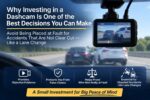
Every day, thousands of drivers leave home believing that if they obey the law and drive carefully, the truth will prevail if they are ever involved in an accident. Unfortunately, that is not always how insurance claims work.
In many accidents, there are no independent witnesses, no surveillance cameras, and no physical evidence that clearly establishes who caused the crash. When that happens, the insurance companies often have to decide whom to believe.
A relatively inexpensive dashcam can eliminate that uncertainty.
The Reality of “Word Against Word” Accidents
Some crashes are obvious. If one driver rear-ends another stopped at a red light, liability is usually straightforward.
Other accidents, however, are far less clear. These include:
- Lane-change collisions
- Merge accidents
- Side-swipe crashes
- Parking lot accidents
- Left-turn disputes
- Failure-to-yield claims
- Four-way stop disagreements
In these situations, each driver may tell a completely different version of events.
One driver may insist:
“I was already in the lane.”
The other may respond:
“No, they merged into me.”
Without objective evidence, adjusters often must reconstruct the accident using vehicle damage, police reports, witness statements (if any), and applicable traffic laws. Sometimes the evidence simply does not establish fault with certainty.
Why This Matters
Insurance companies do not simply pay claims because someone says they were not at fault.
They evaluate available evidence to determine liability.
When the evidence is inconclusive, several outcomes are possible:
- Liability may be disputed.
- Fault may be shared between both drivers.
- Claims may be denied.
- Recoveries may be reduced based on comparative fault.
Even if you were driving safely, the lack of proof can affect your ability to recover compensation for vehicle damage, medical expenses, lost wages, or pain and suffering.
A Dashcam Provides Objective Evidence
A dashcam records what actually happened.
Instead of relying solely on competing statements, adjusters, attorneys, juries, and courts can review the video themselves.
A few seconds of footage can answer questions that otherwise might never be resolved, such as:
- Which vehicle changed lanes?
- Was a turn signal used?
- Who crossed the lane markings?
- Which vehicle had the right of way?
- Did traffic suddenly stop?
- Did another driver run a red light or stop sign?
- Was distracted driving involved?
Video evidence often removes much of the speculation from the investigation.
Lane-Change Accidents: A Perfect Example
Lane-change accidents frequently become credibility contests.
Imagine Driver A says Driver B merged into his lane.
Driver B insists Driver A drifted into hers.
The damage to both vehicles may look nearly identical.
Without witnesses, it may be impossible to determine which account is accurate.
Now imagine one vehicle has a dashcam.
The footage shows:
- Driver B crossing the lane divider.
- No signal before changing lanes.
- Driver A maintaining a constant lane.
- The exact moment of impact.
Instead of debating what happened, everyone can simply watch the video.
Police Reports Are Not Always Enough
Many drivers believe the police report will determine fault.
In reality, officers frequently arrive after the collision has occurred.
Unless the officer witnessed the crash, much of the report is based on:
- Statements from the drivers
- Statements from witnesses
- Physical observations at the scene
Although police reports are important pieces of evidence, they do not always resolve disputed liability.
A dashcam records the event as it happens.
Protecting Yourself From False Claims
Dashcams do more than prove negligence.
They can also protect drivers from:
- False accusations
- Insurance fraud
- Exaggerated claims
- Staged accidents
If another driver makes an inaccurate statement about how the accident occurred, video evidence can quickly expose the truth.
The Cost Is Small Compared to the Potential Benefit
Many quality dashcams cost less than a typical insurance deductible.
Yet the footage they capture may protect you from:
- Thousands of dollars in repairs
- Increased insurance premiums
- Lengthy liability disputes
- Expensive litigation
- Unjust findings of fault
Considering the financial consequences of even one disputed accident, a dashcam is the most cost-effective investments a driver can make.